
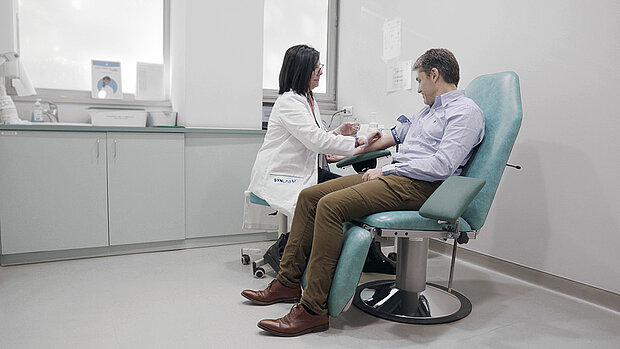
To help raise awareness about this devastating disease, we talked to the SYNLAB expert Dr Harald Hoffmann, who has dedicated most of his professional life to developing worldwide laboratory capabilities in tuberculosis and mycobacteriological diagnostics. Harald Hoffmann leads the prestigious Institute of Microbiology and Laboratory Medicine, WHO Supranational TB-Reference Laboratory (SRL) in Gauting, Germany
The global significance of tuberculosis remains high. Why have we then almost thought it forgotten?
Tuberculosis (TB) remains the deadliest infectious disease affecting humans. It has probably been around as long as humans exist and will remain long after COVID-19 has been forgotten.
Mycobacterium tuberculosis is the most important pathogen of TB. The bacterium is coated with a wax layer. After transmission, the infection enters a dormant phase (symptom-free) in the new host. When the pathogens reactivate, they can infect all organs of the body, including kidneys, bones and brain. However, in about 80% of cases, they populate the lungs. Patients develop symptoms of classical consumption including fatigue, weakness, weight loss, fever, cough and shortness of breath. If left untreated, the disease often leads to death through emaciation, haemorrhage into the lungs, suffocation, sepsis or superinfection.
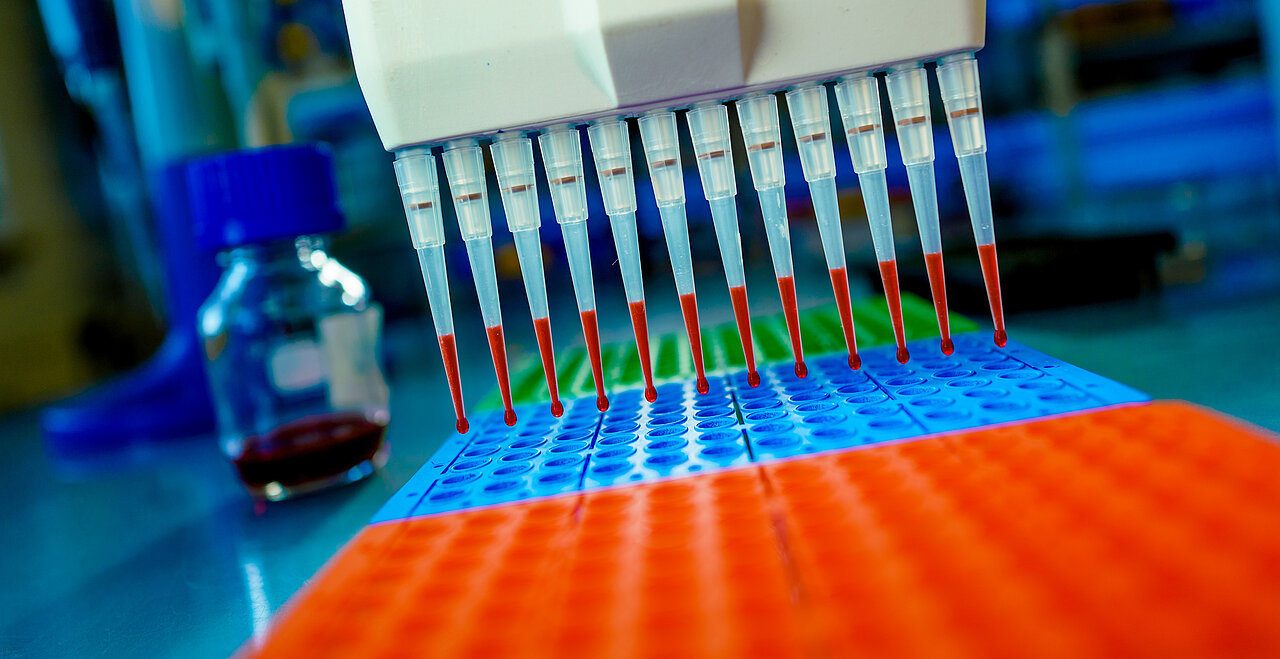
Where is TB found and how is it transmitted?
TB pathogens are transmitted very similarly to SARS-CoV-2 in aerosols, i.e. in mist droplets that patients emit and other people inhale. The World Health Organisation (WHO) estimates that about one fifth of the world's population currently carries the pathogen without knowing or noticing it. 10 million people worldwide are actively ill - only they are infectious and spreading the bacteria.
More than 1.3 million patients die each year of TB. This makes tuberculosis the deadliest disease in the long term – even long after the COVID-19 pandemic has subsided – even more than AIDS.
The Robert Koch Institute (RKI) lastly reported 4127 TB cases for Germany (RKI 2021), which corresponds to an incidence of 5 per 100,000 inhabitants. 90% of TB is concentrated in developing and emerging countries. In Europe, the countries bordering the Black Sea show the highest incidence rates with up to 75 incident cases per 100,000 inhabitants per year. Globally, almost half of all TB cases are found in Southeast Asia and about a quarter in sub-Saharan Africa.
You say that the transmission of the TB pathogens is similar to SARS-CoV-2. Are there other parallels between the diseases?
Oh yes, most of the infection control measures against COVID-19 were already known from TB. Because of the similar infection routes, effective measures could be adopted relatively quickly from TB control. Masks protect against infectious aerosols – also with COVID-19 pathogens. Most transmissions take place in the domestic sphere while outdoor transmission plays only a subordinate role.
Can one fully recover from tuberculosis?
Yes, tuberculosis is curable. Most patients with drug susceptible TB are cured within six months. From multidrug-resistant tuberculosis (MDR-TB) – i.e. a form of TB in which the pathogens are resistant to the most important antibiotics – about 90 percent are cured in Germany. In much poorer high-prevalence countries, especially in the countries of the former Soviet Union, up to one third of TB patients are infected with multi-drug-resistant pathogens. There, however, the cure rate is only 60 percent. Multi-resistance refers to the two most important antituberculotics, rifampicin and isoniazid.
If additional resistance to important reserve antibiotics occurs, it is called XDR-TB. Only 40 percent recover from it. Conversely, this means that 40% of patients with MDR- and almost 60% with XDR-TB slowly die from the disease. Many patients suffer from long-lasting complications. Besides therapy-related hearing loss, kidney failure or neuropathy, patients complain of loss of performance and physical fitness – another analogy to COVID-19.
How is tuberculosis treated?
For drug-susceptible TB, we give four antibiotics for two months, then two antibiotics for four months. For MDR-TB, up to seven antibiotics are combined at the beginning. The patients receive their therapy for at least nine, but usually over 15 to 24 months. Finally, they have swallowed a good 15,000 tablets.
These come with many side effects. TB therapy is particularly stressful for those affected because they have to endure it alone in isolation for months due to the risk of infection. New drugs such as the antituberculotics bedaquiline and delamanid, which were approved in 2014, pretonamide, which is about to be approved, or TMC207, which was co-developed in Germany and still has to prove itself in clinical trials, give hope for improved therapy regimes. How fragile this hope is, however, was already shown by the first case worldwide of resistance to both bedaquiline and delamanid, which we reported in Gauting just two years after the drugs were approved (Am J Respir Crit Care Med 2016;193:337).
What challenges do you face in the fight against tuberculosis, especially in developing and emerging countries?
With no doubt, the biggest challenge is the COVID-19 pandemic right now. Once it has been overcome, the two main challenges we faced already before the pandemic will once again gain momentum: Growing numbers of MDR-TB and co-infection with HIV. MDR-TB is increasing especially in Eastern Europe, Russia, Central Asia, China, Nepal and India, but also in South Africa. The HIV/AIDS co-epidemic, i.e. the co-occurrence of tuberculosis and HIV/AIDS, plays the greatest role in sub-Saharan Africa and South America.
Migration is worldwide growing and challenging public health services. Incomers need to be quickly assessed, diagnosed and treated. In Germany, the health system is excellently equipped for this. According to the Asylum Procedure Act, all refugees and asylum seekers are immediately screened for TB. Thanks to exemplary infection control by our public health services, the disease never spread into the population during the last wave of refugees in 2015. With this experience, we are excellently prepared for future waves that might be to come. I am sure that TB will remain under control in Germany as long as sufficient political priority is given to combating it internationally.

What role do laboratories play in tuberculosis control?
A very central one. Everything depends on tuberculosis being diagnosed in the first place and as early as possible. Once a patient with drug-susceptible TB has received his first medication, he very rapidly looses infectiousness.
With MDR- and XDR-TB, this takes longer, but early therapy protects from consequential damages and complications. In less developed countries, doctors quickly think of TB, but laboratories are rare and often far away. The diagnosis can fail due to such a basic challenge, resulting in patients then spreading the pathogens further and only receiving an effective therapy when the lungs are already permanently damaged. Effective development cooperation in the fight against tuberculosis therefore always involves strengthening laboratory networks and building up new ones.
SYNLAB Gauting is a WHO Supranational Tuberculosis Reference Laboratory. How do you support the global fight against TB?
Our institute has been a reliable partner for laboratory diagnostics in high-prevalence countries for over 30 years. We help state governments to expand laboratory capacity and networks, to replace outdated techniques with modern PCR methods, and to establish logistics and digital data management systems. Doctors will then receive reliable results more quickly and can initiate effective therapies earlier, interrupt chains of infection and prevent complications.
Can you give us a concrete example of this?
Of course. In many regions of the world, TB is still diagnosed by conventional microscopes. Under optimal conditions, half of all TB cases can be found with this method. By comparison, PCR detects a good 80 percent. We help to establish PCR laboratory networks, train staff accordingly and introduce quality assurance systems.
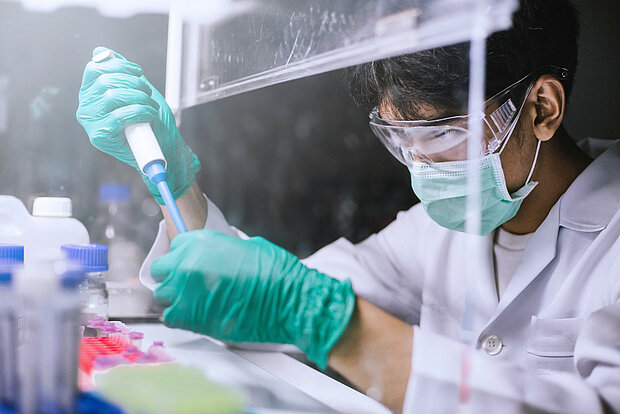
Can you already report concrete successes of your work?
Definitely! In 2006, we helped design and build a biosafety-level-3 (BSL-3) laboratory as National Reference Laboratory in Tashkent, Uzbekistan on behalf of our federal government. We trained the laboratory staff in modern laboratory procedures and introduced a quality management system. The success has aroused interest in neighbouring countries. Meanwhile, all Central Asian republics have built national BSL-3 reference laboratories for TB diagnostics with financial support from the federal government and our know-how.
Kyrgyzstan has one of the most modern TB laboratories in Asia. It was planned in Gauting, prefabricated in Cadolzburg, transported to Kyrgyzstan in seven modules and assembled there. Recently, we introduced Next Generation Sequencing in this lab. This technology is also used to decode SARS-CoV-2 genomes and assign them to possible Variants of Concerns. Similarly, the Kyrgyz NRL can now use the technology to decode the genomes of tuberculosis bacteria and rapidly identify variants and resistances of concern. This enables the public health system to respond immediately. Together with our local partners, we have used the NGS technology in two important studies on transmission pathways of TB in the Kyrgyz community.
How will the fight against tuberculosis continue in the future?
Now that our partner countries have upgraded their laboratory and testing systems, modern data management and improved sample logistics are the keys to faster and professionalised diagnostics. This is where SYNLAB, with its rich experience, can contribute a lot to improvement.
State-of-the-art technologies such as the aforementioned next-generation sequencing must be made available to all high-prevalence countries and used as integral components of TB diagnostics in accordance with the current WHO recommendations.
Research must focus on developing even faster and cheaper diagnostic methods, ever newer antituberculotics and regimens to overcome resistance, and effective vaccines. These three – but especially anti-TB vaccination – are real game-changers in the global fight against TB.