

Could changing how we offer cervical cancer screening save more lives?
Every January, Cervical Cancer Awareness Month reminds us of the importance of regular screening and early detection. But despite decades of public health messaging, participation in screening programmes remains too low in many countries.
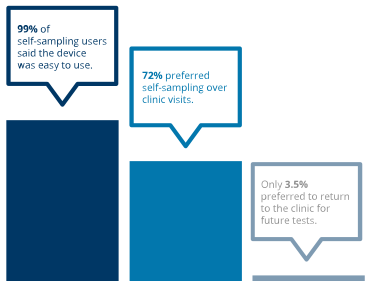
A new study from Estonia may hold the answer. By giving a choice between traditional clinician-based sampling and self-sampling at home, researchers saw a significant jump in participation in HPV testing. The results speak volumes:
- 99% of self-sampling users said the device was easy to use.
- 72% preferred self-sampling over clinic visits.
- Only 3.5% preferred to return to the clinic for future tests.
In this interview, we explore what these findings mean for the future of cervical cancer prevention and how a simple shift in strategy could transform national health outcomes.
What motivated the design of this pilot study in Estonia?
There were three main reasons why this randomised pilot study was initiated in Estonia:
- High cervical cancer burden: Estonia has had persistently high cervical cancer incidence rates since the early 2000s—nearly twice the EU average and about four times higher than its neighbour Finland. This has also led to higher-than-average mortality rates, impacting patients' lives and unnecessarily burdening public health services.
- Transition from cytology to HPV-based primary screening: The national move toward HPV-based primary screening created an opportunity to evaluate alternative screening approaches—such as HPV self-sampling—within a real-world, population-level context.
- Increased readiness for self-care innovations: There is a broad shift in the public mindset. Individuals are transforming from passive patients to informed actors taking ownership of their health. Furthermore, there is greater awareness about new and innovative healthcare options, improving access and uptake. This development has enabled the introduction of HPV self-sampling within a randomised study, marking an initial step towards potential integration into the national screening programme.

What were the main results and key findings?
The study showed that personalised intervention (for example personalised letters) to encourage participation in cervical cancer screening led to higher engagement compared with the general, anonymous approach used for the control group. Moreover, the opt-out arm—where participants received a self-sampling kit directly by mail—achieved the highest participation rate among all study groups.
In addition to participation differences across age groups (notably, women aged 60–65 showed the greatest increase in uptake when receiving the self-sampling kit by mail), the study also demonstrates the potential to reduce healthcare costs by decreasing the number of required clinic visits. Only women with screening results indicating the presence of high-risk HPV strains (13.8% of all participants) needed to visit a healthcare facility. This is particularly important given the severe shortages of healthcare personnel and limited public-sector health insurance funds.
Why do you think the success rate is higher if participants receive the self-sampling kit directly by mail (versus having to order the kit themselves)?
We believe participants are more likely to act when they receive the self-sampling kit directly. This is driven by a sense of obligation and the ease of having all essentials ready: instructions, materials, and a simple, pre-arranged return process.

What do the high satisfaction rates (99% ease of use, 71.9% preference) suggest about the future of self-sampling in national screening programmes?
The very high satisfaction rates indicate that self-sampling is likely to play an increasingly important role in national screening programmes. Real-world evidence already demonstrates strong progress: in Estonia, overall participation in cervical cancer screening rose from 45% to 65% between 2020 and 2024. With a current rate of 65%, we are close to meeting the World Health Organisation (WHO) target for cervical cancer elimination, which calls for at least 70% of women to be screened globally.
Additionally, self-sampling—now a standard option in Estonia—accounts for around 20% of all screening participation, with some variation by age group and region. Since 2025 there is also the possibility to pick up a self-sampling kit directly from a pharmacy.
Could this model be adapted to improve participation in other low-uptake health programmes?
Yes. The principles and experience gained from this model are already being explored for other low-uptake health programmes by the National Institute for Health Development. SYNLAB Estonia has also participated in a pilot study assessing the feasibility of a publicly organised prostate cancer screening programme using PSA testing. A key component in this pilot was providing a digital platform, enabling convenient sign-up and appointment booking, combined with easily accessible sample collection sites to simplify participation.
Another project under consideration is the integration of colorectal cancer screening (faecal occult blood testing) with H. pylori antigen testing into a single, streamlined workflow. Such a combined, user-friendly approach could similarly improve participation rates in other screening programmes and reduce the burden placed on the public healthcare system.