
Approximately 850 million people worldwide suffer from chronic kidney diseases (CKD) and almost 90% of people living with renal diseases are unaware of their illness, resulting in kidney failure and eventually the need for dialysis or transplantation. Most acquired and hereditary kidney diseases exhibit few to no symptoms at all in their early stages – which is why they can go completely unnoticed.
We interviewed two of our experts in nephrology, Prof. Dr med. Walter Hofmann at SYNLAB Germany and Dr Olivia Shaw at Synnovis to get insights on dialysis treatments, kidney transplantation and the importance of having guidelines for diagnosing kidney related diseases.

Prof. Dr med. Walter Hofmann
Specialist in Laboratory Medicine
Clinical Chemist
SYNLAB Germany
What exactly is dialysis and how does this procedure work?
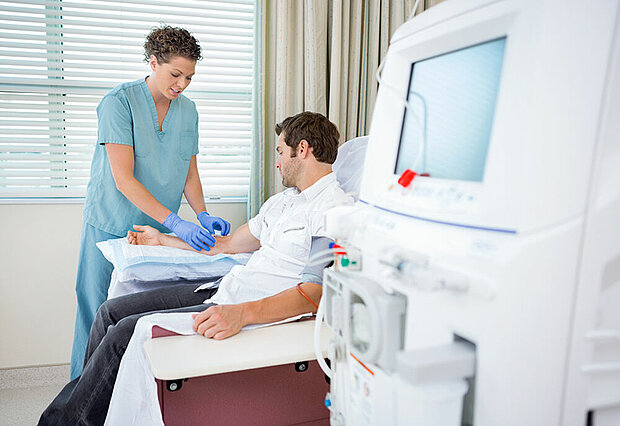
Dialysis treatment is used to filter waste products and excess fluid from the blood of a patient whose kidneys are failing. In almost all patients with end-stage renal failure, in addition to possible anaemia, there are signs of a bone metabolism disorder caused by vitamin D deficiency, a so-called renal osteopathy, or mineralisation disorders.
Four types of dialysis are common: peritoneal dialysis, haemodialysis, haemofiltration and haemodiafiltration. Peritoneal dialysis (PD) is the process of blood filtration performed in the patient’s abdominal cavity via a catheter where a natural, semi-permeable membrane called the peritoneum filters the blood. Haemodialysis, haemofiltration and haemodiafiltration are all similar with some differences. They all use an artificial kidney, called dialyser, to filter the blood. The only difference is that haemodialysis removes solute toxic substances by diffusion while haemofiltration removes both solute and solvent toxins and water by convection. Haemodiafiltration combines both diffusion and convection to cleanse the blood.
Are there alternative treatments or therapies being researched as an alternative to dialysis for patients with kidney failure?
Other than dialysis, kidney transplantation is the closest option to a kidney replacement procedure.
What role does SYNLAB's expertise play in dialysis?
Early detection and diagnostics play a huge role in preventing renal diseases developing into kidney failure. The aim is also to innovate to improve or replace previous practices for monitoring relevant kidney biomarkers to be able to respond sooner. The search for kidney organ-specific markers must continue, these must be evaluated and then introduced into routine diagnostics.
For example, in Germany SYNLAB provides medical professionals with a guide, a so-called pocketbook, for the differentiated diagnosis of kidney diseases, reflecting the latest knowledge of essential guidelines.
What do guidelines such as the “European Urinary Guidelines” do to support diagnostics?
Our exchange with colleagues nationally (DGfN/DGKL) and in Europe (EFLM) was very valuable. The resulting guidelines represent important building blocks for standardised laboratory diagnostics of kidney diseases – both on national and European level.
The national and the European guidelines complement each other well. The German guidelines focus on medical requirements and diagnostic instructions, while the European one advises on the analytical and practical approach: which examination is needed for which situation.
What else would you like to share in your role as a professional in the field of laboratory medicine?
Laboratory diagnostics link patients and medical professionals by detecting possible kidney diseases earlier, treating them adequately and hence avoiding the use of dialysis.
New approaches could also include evaluating the measurement of data sets of individual patients over time using artificial intelligence (AI) to detect abnormalities and tendencies earlier.
Dialysis and transplantation are the only available treatment currently for end stage renal disease.

Dr Olivia Shaw
Laboratory Director
Consultant Clinical Scientist
Clinical Transplantation Laboratory
Synnovis United Kingdom
Why are kidney transplants important?
The simple answer is that kidney transplantation improves and saves the lives of patients suffering from end stage renal failure. Kidney disease refers to a wide range of conditions that can lead to an individual’s kidneys no longer functioning optimally. Kidneys are one of the vital organs of the body: They act to filter blood, removing waste products and toxins that are excreted as urine. They also maintain an individual’s fluid balance and control blood pressure amongst other things. Kidney failure may be acute or chronic, depending on the severity of loss of function.
Dialysis and transplantation are the only available treatment currently for end stage renal disease (<15% kidney function). Without either of these options a patient would die. Whilst dialysis is life extending, it severely impacts the lives of patients, their families, and carers. The average patient on dialysis will spend over 12 hours a week linked up to a machine and may suffer from side effects, such as tiredness, weakness, nausea and itchy skin.
Kidneys are the most commonly transplanted organs and can be donated by both living and deceased donors. With a functioning transplant the impact of the disease is largely diminished. Whilst there are many factors at play, the average life expectancy of a patient on dialysis is 5 – 10 years, whereas the survival of the average transplanted kidney is 15 – 20 years from a deceased donor and 20 – 25 years from a living donor. Successful kidney transplantation can offer a life changing opportunity to return to a healthly and relatively normal way of life.
With around 500 transplants a year, the Clinical Transplantation Laboratory at Synnovis is one of the leading labs working with transplants in the UK. What role do laboratory diagnostics play?
Many factors impact how successful a transplant will be, the most important being the compatibility between donor and recipient. Despite all transplant recipients receiving lifelong immunosuppressive drugs, rejection of the organ by the immune system is the leading cause of transplant failure. The job of the Clinical Transplant Lab is to assess donors and recipients for incompatibilities and achieve the best possible outcome for each pair.
The main area of focus for us is the HLA system. HLA are proteins expressed on the surface of nearly every cell in the body. Many thousands of different HLA genes and proteins have been identified worldwide, with the number ever increasing. Their normal job is to control an individual’s immune response, enabling them to respond to infectious pathogens and disease. However, the HLA proteins on the surface of the transplanted donor organ become the target of the recipient immune system. Even slight differences in these proteins between a donor and recipient can trigger a strong immune rejection response. This diversity presents significant challenges when trying to match recipients with donors for transplant. The better the HLA match the better the long-term survival of the transplant.
We also assess the patients awaiting transplant for HLA specific antibodies. We need to identify these antibodies to ensure that the patient is not offered an organ that would be unsuitable due to antibody incompatibility. Patients may produce these antibodies in response to ‘sensitising events’: Common examples include previous transplants, blood transfusions and pregnancy. The more antibodies a patient produces the harder it is to find a compatible donor organ and often the longer they will have to wait. The production of these antibodies fluctuates, so we monitor patients regularly to ensure we have the best information available when deciding if a donor organ is compatible.
With the HLA typing and antibody information available we can assess the immunological risk and advise the clinical team as to whether transplantation should proceed. In the case of living donation this can be done over a longer period, however for deceased donation, where time is critical, we are on call 24/7 to provide assessments.
As an active member of the British Society for Histocompatibility and Immunogenetics, what developments are you looking forward to in kidney diagnostics, transplants, and therapies?
There are so many areas in transplant immunology that benefit from new, innovative technologies. Next generation sequencing for HLA typing is one example, whereby laboratories are now routinely able to achieve high resolution HLA types in a matter of hours.
Another area gaining traction is the use of ‘epitope’ matching as opposed to matching at a whole protein level. Whilst still theoretical, it is likely that there are far fewer individual epitopes than there are whole HLA proteins. This could enable better and easier matching, with improved transplant outcomes. It could also be used to identify transplants that are more immunologically challenging and would benefit from higher levels of immunosuppression or monitoring. Furthermore, investigations into the production of antibodies to variable targets other than HLA and their association with rejection and failure of transplants are going on around the world, with the aim of providing a greater understanding in compatibility matching and immune response monitoring.
Innovations to improve patient comfort is also a key area of interest. Often patients with suspected rejection will be required to undergo biopsies to allow treatment before the damage becomes too great. Each biopsy is an invasive and uncomfortable procedure, carrying risk to the organ and the patient. A new alternative is to use a simple blood test to identify the presence of small amounts of DNA derived from the donor organ, with higher levels of circulating donor derived DNA being an indication of organ damage and possible rejection. As routine testing this could allow a reduction in the number of biopsies and improve patient care.
In addition, new therapies around immunosuppression to enable transplants to last longer, or allow transplantation on immunologically difficult patients, are close on the horizon. Overall, many exciting changes will allow us to continue to provide the best support for better transplantation outcomes – which benefits the patients, their families, society, and, most importantly, best honours the ultimate gift of the donors and their families.